Principles group 2
principle as expressed - a fundamental, primary, or general law or truth from which others are derived
OK I am not looking for bend the wrist, weight on balls of feet kind of stuff yet. I am looking for fundamental truths/laws/ideas that apply to all aikido at least damn near every time.
Maybe something like blending or nonresistance? Do you think that would go good in this category?
saya no uchi
Takeda Sokaku defined aiki in the following way: "The secret of aiki is to overpower the opponent mentally at a glance and to win without fighting."
"Standing before the enemy, he strikes but I am already behind him." - Ueshiba Morihei
Control of and correct use of timing - this gives rise to all of the aspects of initiative, reaction, rise and fall, flow.
Attaching to energy - gives rise to following motion, evasion/tenkan, invasion/irimi, commuting locks, matching, softness, blending.
Best use of strength - gives rise to using center, ikioi/hazumi, good body mechanics, unbendable arm, weight underside, same hand same foot, etc.
Mutual benefit - gives rise to harmonizing, ethics, transcending victory and defeat, personality development.
As you can see, at this level these apply in various aspects to lots of, if not all, martial arts. Maybe this is not what you are looking for?
No I think these are great. The last one was Aikido only (ish) Personally all these arts look the same to me anyhow. I want to hear what the thinkers of the Kaze Uta Budo Kai see as there pet principles. Bieler Sensei your contributions are perfect and will be plagiarized for my insidious purposes.
Anyone else got something?
The principle of aiki transcends victory and defeat, steps out of the dualistic frame of reference and expresses a non dual reality where in buddhist terms we could say that samsara is nirvana, form is emptiness ... As nev sagiba put it recently, Primordial chaos is inherent harmony. This is the place where the whole world can become one family. Self and other loose the hard edge of separation and the spontaneous play of the whole operates through the medium of the players. We do not use the principle of aiki, it becomes embodied in us.
Neat stuff, you guys, but personally, I'm more Physics than Philosophy.
But, I do have something to toss at you.
Sensei Raymond told me one time, "You learned almost everything karate had to teach you in Basic Form One."
To which I answered, "I didn't take karate, i took tae kwon do, Ray."
And he replied, "Whatever. You know what I mean." And I did.
Take a look at these "fundamentals" that I learned from my first H-Pattern Poomse.... bet you'll notice some familiar stuff.
Stand up straight
move from your middle
keep weight as evenly distributed as possible during movement
try to keep your hands in front of your shoulders
keep your weight off of your heels, but don't be on tip-toe, either
Get the hell out of the bad guy's way
Always begin by protecting your head and neck with hands and arms, oddly, it's easier to move the other stuff out of the way
The one that still comes up the most is the first, stand up straight. I think about it as not taking overlarge steps, not bending over (duh), like that. It's amazing to me how nearly every art's highest-end practitioners, when in motion, tend to look very much alike, except for the vagaries of attack/defense (kicks vs. throws for example).
Hello everybody,
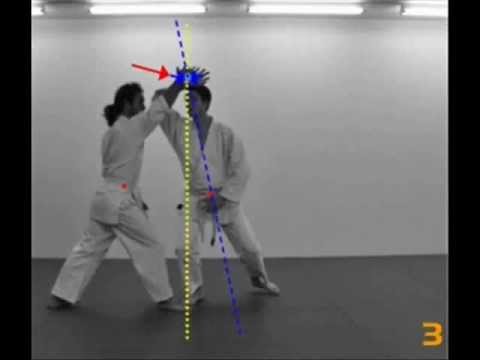
I try to find out what are those principles that are used within Aikido. I cannot understand philosophical approaches, my bakground is technical, so my conclusion is depicted in a small video I created.
.
In this video i tried to put the forces that appried by both uke and nage. It is not 100% accurate but shows clearly that during a technique the bodies should be in balance from the first contact to the end. This video shows also that nage's response is not depended on uke's size or power.
I hope this simple example gives an idea of how Aikido works.
nice work! -- i think the technical and mechanical side goes along way toward describing what happens in aikido-- there are a huge number of aiki functions that can be expressed this way! I also think there are a set of functions that are better described less as mechanical actions and more as communication or perhaps even better as information theory where what makes the technique work is not so much mechanical forces but rather a confusion of the targeting and proprioceptive systems-- such function are non reducible to the the mechanical model and require some depth of understanding of the nervous system and neurological functions -- its like einstein said -- make every thing as simple as possible, but not simpler
Well, the approach with the mechanics is the one that will do a new Aikido student to start working under some principles. As an example, why a new student to keep the contact with his/her partner? How is going to understand to be centered, to be present. And to do all these in a meaningful way.
For me, what Morihei Ueshiba may had in his mind when defined Aikido (i.e to be in harmony with the universe) I understand to behave under the laws of universe or the laws of nature. The last are described under the Newton's laws of physics. I feel that AIkido is so simple at least in the early stages of an Aikidoka training. After years of training the same forces appear but without any contact since the technique is completed upon uke's intention. Of course I have no doubt that this approach is not easy to understand from someone who has no technical mind. It is difficult. From me, all the other phylosophical and non approaches does not help practicioners during their daily practice. The objective of them may be other. But for Aikido the contact, the connection, the balance are all tangible concepts.
In the above video, it is explained why each role keep the connection (blue arrows), why this connection is constant through out the techique, why the connection point is not moving relatively between the two bodies (action=reaction, blue arrows), why uke is led away from nage (red arrow)? Why they do not have to use muscular power (the excess power -red arrow- is always in the peripheral of the movement)? And so on.
Conversation on those issues does not end!