Finishing

Started by Sean Ashby · Jul 2, 2009 · 26 posts

(368 posts)
Finishing
How come we don't finish certain techniques much anymore (like taking oshi taoshi, hiki taoshi, kote gaeshi, etc. to the arm bar on the ground, etc.)?
(1808 posts)
In Judo, we sure seem to terminate the majority of the throws. In Jyodo, we sure seem to finish in a superior position of control.

I believe this anomoly crept in over the years. We gradually stopped taking techniques to completion while working on the KiHara(tm) Aikido system developed by Geis. I think the concept was nothing will work anyway, so why worry about terminating it since uke will give you another technique when he survives the last one. When you work with guys like JW Bode, you get a sense for taking techniques to a very terminal position.

I think focusing on throws & locks is probably a very good idea. If you don't do it in class, you might not be able to do it in the real world should the need arise.
(368 posts)
I guess it all comes down to how you end up using aikido, in a "survive and escape" situation or a "control and subdue" situation. I imagine a policeman or prison guard needs to have a good idea of how to pin and controls someone. The regular guy on the street, perhaps, just needs to get the hell outa Dodge.

Still, maybe it's a drunk brother-in-law or somebody you know, or a situation where you can't flee (like Cindy's incident in the hospital) and knowing how to keep someone in control might be a good idea? Just wondering....
(583 posts)
i think revisiting the finishing locks is terrific -- i'm all for it
(1808 posts)
Sean Ashby wrote:I guess it all comes down to how you end up using aikido, in a "survive and escape" situation or a "control and subdue" situation. I imagine a policeman or prison guard needs to have a good idea of how to pin and controls someone. The regular guy on the street, perhaps, just needs to get the hell outa Dodge.

Still, maybe it's a drunk brother-in-law or somebody you know, or a situation where you can't flee (like Cindy's incident in the hospital) and knowing how to keep someone in control might be a good idea? Just wondering....


Agreed. It's a completely different paradigm (to me anyway) relative to self-defense. Obviously police & corrections officers need to control & subdue. I find this to be a higher difficulty than just getting away. If you can lock it up, you can always release & run. But if you always run away, you may not be able to lock it up if you need to.

Cindy's had two different instances. The first was clearly a get the hell outa Dodge. The second instance, leaving wasn't an option on the table. Different scenarios, different levels of control. Both are real-world scenarios that might be worth studying.
(368 posts)
Yeah, Cindy's a good example of both.

I was also interested in "finishing" in the sense of taking a technique to completion. Brent brought this up the other week in morning class, and it's been on my mind since. In other words, we have a habit sometimes, particularly with renraku waza/release series, of skimming over a given technique knowing we're going to move on to the next one. Now, I definitely understand the value that these sorts of exercises have brought into the system; wouldn't change it for the world.

But sometimes, we end up sort of dancing around with uke near the edge of the cliff, in the vicinity somewhere (maybe he gets close, maybe not) rather than each time conscientiously placing uke right on the edge, and when he tries to recover, we use that to put him on another edge, until his recovery is so drastic he falls off the edge (if that makes any sense). It's something I've been thinking about in my practice, anyway...
(1808 posts)
It reminds me off Moose and the litany of Judo. The throw is over when uke is on the ground. Even in Judo we often pull short of completion -- failing to complete a sweep or reap, or potentially enter into what I call partner throws.
(368 posts)
Yep, I'm guilty of that.

I'm also inspired by jodo. The jo guy is all up in uke's grill, puttin' up that wall, rarely giving uke much room until his jo us up uke's nose.

And wasn't it Moose who also used to say "like white on rice, like stripes on a tiger, like death on a dead man!" 😄
(1808 posts)
Sean Ashby wrote:
And wasn't it Moose who also used to say "like white on rice, like stripes on a tiger, like death on a dead man!" 😄


Sure 'nuff.
(134 posts)
we have a habit sometimes, particularly with renraku waza/release series, of skimming over a given technique knowing we're going to move on to the next one

There is a fundamental lesson of giving each technique and each off-balance a chance to actually work. Like being patient enough on the initial off-balance of the first release, taking it to full extension and waiting for uke to change the direction, so if uke's attack is strong enough you allow him to throw himself. We should not release a grip until it is failing, not bring the second hand into play if it's not needed, etc. Sincerely attempting the original technique is especially important on kata like yon kata 8-14.

I think we stopped taking techniques to the lock because in many cases it requires kneeling. This isn't just about one person, but also marketing for an aging student base. Although, I get as many college kids as boomers.

I'm also inspired by jodo. The jo guy is all up in uke's grill, puttin' up that wall, rarely giving uke much room until his jo us up uke's nose.

Me too. Koryu has a certain feeling to it. Oh yeah, it's called BU.
(106 posts)
Funny how you guys bring up the same problems I am wrestling with at the same time. Weird.

I have read several teachers say Aikido is 60 percent ground restraints - and I have felt my own practice move away from that. When I was focused on Daito Ryu EVERYTHING ended in restraint. When I was training with Waddell and Fowler in the 1990s 70-80 percent of technique ended in restraint. One of the guidelines Clark Sensei had was to try to restrain while standing so you can deal with the next guy when he comes in. The only techniques I recall going to the knees was shiho nage and ude gaeshi. As I recall, Clark said in a seminar back then he never really liked those restraints.

Even though I have been a little lax about restraints, we continue to keep the engagement dangerous even when uke is on the ground. He has the right to sweep, pull down and trip tori if he can. This rule has helped us maintain zanshin, good post-waza maai, and it helps lead into more dimensions of Aiki problems and solutions. In Matl Sensei's Judo he insists we reach a place of strength and safety within one step after the throw. He does not emphasize the locks in class, but says if you really need it step on their face. Works for me.

I say there is a curse in much of Aiki. It is the notion that Uke * dies upon impact *and fails to be dangerous while on the ground.
Perhaps we should start randori with one person on ground and one person standing. Alternate positions and who initiates the attacks. I betcha you would get some interesting results.

Another thing to consider - when Daito Ryu was my focus, the restraint typically happened in the moment between throw execution and uke hitting the floor. By the time uke finished falling he was typically already 90 percent restrained.


Glad to be here and posting. I dig the Kaze Uta vibe.

Walk In Peace,


Eric Pearson
KyuRyu Aikibudo
http://tomikiaikido.blogspot.com/
(368 posts)
Cool, thanks Eric. Good stuff. And what you said about "zanshin, and good post-waza maai" is every bit as true. That struck a chord with me just now. It brings to mind things that other teachers have mentioned lately that echoes that idea, that just suddenly all clicked into place. Hmm.

Anyway, welcome!
(231 posts)
Let's not forget that some of this comes from working with "falling adverse" ukes as well. Not everyone need to be taking a ton of falls, and even the craziest of us can't do it all the time. Still, I think the easy, flowing atmosphere tempts us to not take a ton of falls. And it's easy for tori to say "well, I basically got you, if you don't want to fall I won't kill you."

It's definatly a different feel when the crazy ukemi monster is on the other end. You can't slack up with him, because he doesn't give up the throw. He's not afraid of the extra juice... he likes it.
(1808 posts)
Chris Wilson wrote:It's definatly a different feel when the crazy ukemi monster is on the other end. You can't slack up with him, because he doesn't give up the throw. He's not afraid of the extra juice... he likes it.


You say that like it's a bad thing. 😂
(81 posts)
I say there is a curse in much of Aiki. It is the notion that Uke * dies upon impact *and fails to be dangerous while on the ground.


I agree that its easy to fall into that mindset.. so I always try to ingrain into my students heads to clear the space and maintain zanshin after the throw is over..

Sometimes I'll gently remind them by grabbing a leg or showing them that they are still in my striking radius...

As far as finishing locks go, I always find myself emphasizing them heavily for awhile and then later on not so much... Then I stop and wonder why Im not doing it anymore and start working on them again...

I think it goes back to the duality of "survive and escape" or "control and subdue" as mentioned before... both are equally as important and its good to go through periods where you focus on one or the other to keep them fresh on your mind...
(368 posts)
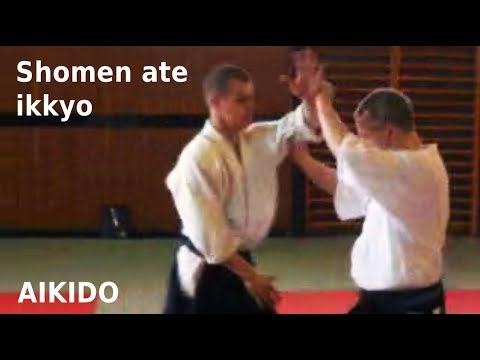
Oshi taoshi is another one I wonder about... Not just the arm bar on the ground, but the whole pushing the elbow through the ear part, what I believe the Ueshiba guys call "ikkyo". It's a very dynamic control, and I've seen a lot of Tomiki styles do it the same way (I'm not saying that makes it "right", I just think it's interesting). Lately, it seems like we get the elbow to the ear, and then just stop and as if to say, like Chris said, "Well, I basically got you, so..."

(Here's a brief video to get the idea of what I'm talkin' about):

YouTube video

I can imagine that one might be tempted to put too much power into it, but done at the right moment... It seems like we do it this pronounced in the first technique of san kata or in the one where you disarm an uke with a sword later on in that same kata. Hmm. Just wondering...
(583 posts)
i think alot of it is folks just get kinda lazy sometimes-- they dont feel like doing the full ukemi and they keep the workout light by just dropping off the kake
(583 posts)
Funny how you guys bring up the same problems I am wrestling with at the same time. Weird.


funny how that works aint it?

finishing locks are well an good -- they definatley come in handy, but i dont get all excited by them-- locking to me is more interesting as a form of imposing asymetriical torsion to dynamic systems, e.g. locks that lead to throws --
holding someone in a submissive position just aint that attractve (a slow and greuling form of wisdom) -- making all upsidedown in new and unexpected ways! (fast wisdom -- like a blow from a keisaku) -- now that seems exciting-- ive just always favored sudden enlightment

as to hitting the ground = death --Daigo says this was the original meaning of ippon in judo-- i guess if we learn how to not put people on their heads we are also indirectly learning the how to put people on their heads -- play nice now

still i agree one must remain engaged and aware of threats from below and have competence in handling all and sundry
(368 posts)
Yeah, I'm not in love with locks and restraints, and I think it would just wear a guy out having it done to him over and over. I just like touching on it hear and there, knowing it's there, keeping it in my back pocket...
(13 posts)
I am not well versed enough in the arts to chime in with you guys, but one thought came to my mind. From the discussion here it seems that the submission locks are important enough to be covered in class at least occasionally. Therefore, if the people that know how to do them well (you guys) don't apply them to the people that don't know them well (me), then we may not learn them effectively. I guess I just signed up for some arm-barring.