Let's Discuss "Wicked Gedan-ate" & a movement from the walk

Started by Kyle Sloan · Jul 19, 2009 · 17 posts

(1808 posts)
Let's Discuss "Wicked Gedan-ate" & a movement from the walk
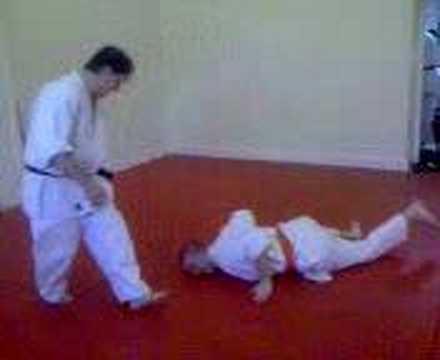
My apologies for the quality of the video. It's a trade-off for size versus quality, and shot with an outdated digital camera. It's what I had available at the time.

About a year ago we had some discussion regarding gedan-ate, as well as what some folks call a "mystery move" from the walking kata. Movement #9 of the walking kata (soto-mawashi-gaeshi) is unique in that it is the only place we see tori complete back-to-back rising motions. Many of the other movements in the walking kata are very obvious, and we see them crop up in techniques. But this 9th movement... where does it appear?

We can apply it in gedan-ate. In this video, Prentis lifts his arm to create off-balance and enter (at about the 0:06 mark). It is important for tori to be palm up, and lift the arm straight up. Sometimes in the walk I see people lift the arm and it goes into an arc, traveling backward toward their head rather than straight up.

http://www.youtube.com/v/6boikLuKG08


So, I have two topics to discuss:
1. The 9th movement of the walk; where else do we see it, and how else can we apply it?
2. Is this really gedan-ate? Why, or why not?
(583 posts)
here's few thoughts--
staight up is the way--coiling back is a no no -- this rising kuzushi can also be applied nicely toward the end of yonkata as a rising catch in a back step -- we also see it in the last form of kogures double wrist releases where it sets up like a upward wrist coil to a winding action like sode-tsurikomigoshi -- it is also a useul body dynamic(without the arm) under tension particularly when a drop action will only get you stuffed deeper in hole--

is this gedan ate or a gykugameate? yes -- as we see in the 15 (predecessor to the 17/23/??) both originated at or about the shoulder line and divererged in execution from there-- so i guess it is closest to a really old fashion gyaku but with just a little extra knee bend here it would certainly qualify as gedan

just my 2cents
(231 posts)
I know a lot of people have heard this story before, but one noon class Jum Ellison was talking about this stright-up lift to set up gedan ate. He knocked the holy dog urine out of about three of us with it. Yeah, he did it basically as an accident. Catch it on the rise and watch the chaos.
(1808 posts)
The body lifting aspect of this entry reminds me a lot of okuri-ashi-harai in Judo. I see the technique as gedan-ate because we're below the arm, not attacking the eyes. However, I also think it could be considered gyaku-gamae-ate because the posture is not as low as some Aikido systems prefer. As uke, I'm glad tori doesn't drop in a low shearing line. The fall is bad enough as it is. To add additional drop to the throw would be pretty nasty for uke.
(106 posts)
I hate to be the literal translation guy, but gedan ate means "low attack"

A straight lift like shown here would qualify it as a high attack.

Almost univesally in the Tomiki world I see the gedan ate being used as gyaku and vice versa.

Gyaku does not mean head push. It speaks of the opposing stance. Most of the time when you in opposing stances you are doing gyaku. I don't care about how the connection is done (what the hands are doing)

Gedan ate means low attack. It is clearly different in that while it is done opposing stance, the principle must be different for us to keep it in the kata.

To me, Gedan means a connection that is low enough that it does not load weight onto the spine of uke. Instead a gedan ate displaces the hips, or is a pure hazumi irimi movement. In motions I consider to be be gedan ate, uke's spine will often bend forwards rather than backwards as weight is loaded upon it.

These definitions are the only ones i have yet come up with to separate the two techniques into genuinely different techniques. Otherwise they are just variations of each other.
(40 posts)
I watched the clip probably 100 times.. I like it it.
First I want to explain in words how I perceive some of the differences in techniques by what level of the body is being effected..
for the sake of my slow typing fingers and lack of literary ability I will be as short as I can. I see the body being separated into three distinct sections. Just as if you hold your jo in the center, I count the top (head/chest) as #3, the center (abs/hips) as #2, and the bottom as #1 (feet) (how uke can fall, #1 he can trip, #2 he can have his center pushed past his base, and #3 he can have his top pushed over his base)
The way I see the differences between the two techniques in question, is that gedan is a Hazumi movement but at a downward angle locking the spine as well limiting the recovery step affecting the 2nd level or offbalancing him from his hip level. Where I think of Gaku as a pure off-balance technique that off balances him at the top or 3rd level as you step through his center line.
When I am in position for Gedan I do try to posture so that I can not only step through uke's centerline, but also lock his spine helping limit his choices of movement. to me this not only makes things more simple for me to understand what and why but also to break it down into smaller pieces for my students.
So yes gedan I do define and think I practice as a low strike. As you are affecting the 2nd level of the body but is not correlative to locking the spine or not as I see it now.

Thoughts?

Jeff Duncan
(368 posts)
You can also look at the first 5 in terms of the difference in the angle that you're attacking uke's center line. Think of it as working your way around a clock.

Shomen ate and aigamae ate (1 and 2) the angle of the push is mostly straight on (my shoulders and uke's are facing each other).

Gyakugamae ate gets a little different. The name (reverse posture) implies that I'm A) on the outside of his arm (with #1, I'm totally inside; with #2 his arm is on the other side of my head but I'm still facing him, and my hand is pushing forward), and B) I'm now using the other hand. My posture is reversed. I'm still pushing on the top part of uke while the bottom part keeps going, but now my shoulders are 90 degrees to uke.

With gedan ate, my arm is not just under uke's but my push is lower on uke's center line, and I think you could think of it as hip level, sure, crumpling his posture from the middle (interestingly, you can also do #5 ushiro ate by grabbing uke's hips instead of his shoulders and get a nice mid-body crumpling effect). My shoulders are now facing the same way as uke's and my push is out to my side.

Now, the way we've done it for a long time was to bend uke's posture back, then push through him in a sideways fashion, off his far heel, causing uke to take a side fall. Lately, though, I've seen some interesting Tomiki versions where tori crumples uke's middle and causes uke to spin/flip backwards over tori's thigh, which looks like a helluva ride and a way of looking at it that I haven't explored much.

By the time we've worked our way through the series to ushiro ate, we've traveled all the way around uke, attacking his center line from different angles until we get to the back angle (at which point we get a hook instead of a push, but it's still affecting uke's center line).

All that being said, I think how Prentis got INTO position for gedan ate is one way to do it, but it's still gedan ate at the end of the day. Maybe I'm holding uke's other hand with my other hand and I just lift it over my head to open him up (classic kata entry) or maybe we use the lifting arm thing like Prentis to not only open uke up, but also creates a strong body rise so we can do our gedan ate on his big body drop. Or maybe he's pulling my arm into waki gatame and not doing a proper job of it, and I step into gedan ate. Several ways to get there, but it sounds like everyone's getting gedan ate in the end.

Anyway, the angle/direction of attack is another way I like to look at the series.
(1808 posts)
Sean Ashby wrote:Lately, though, I've seen some interesting Tomiki versions where tori crumples uke's middle and causes uke to spin/flip backwards over tori's thigh, which looks like a helluva ride and a way of looking at it that I haven't explored much.


I think you've explored it, but you might not recognize it.

If you look at sukui-nage in Judo, we do it with a sliding leg. This is much nicer to uke, though it seems like a cross between yoko-otoshi & tani-otoshi. Yoko-otoshi is typically throwing uke forward, as tori slides downward. Tani-otoshi throws uke backward, though the body position of uke & tori is much different than where we begin sukui-nage. Tani-otoshi has a reputation as a leg breaker.

Sukui-nage, when it's done as the full meal deal, involves not sliding. Your knee is bent, and uke is sent flying backwards as you describe. Here's a link to a drawing of the technique at JudoInfo.com. The full ride sukui-nage should really be practiced with crash pads. You might even want to double stack them. I hit Cameron with it to show folks what we were really doing, and he didn't want to take the ride again. It's pretty brutal for your uke.
(106 posts)
Sean Ashby wrote:Gyakugamae ate gets a little different. The name (reverse posture) implies that I'm A) on the outside of his arm (with #1, .......... but now my shoulders are 90 degrees to uke.


No sir, I disagree with this evaluation. The name implies what it says "opposing stance" Outside or inside is irrelevant. I am not seeing the shoulder angle either as a universal truth in the naming of this technique.

Times we see gyaku inside or uchi

San Kata

Suwari-waza (First Section - Kneeling Techniques) - 2. Gyaku-gamae-ate
Tanto-dori (Third Section - Standing Techniques, hand against Knife) 2. Gyaku-gamae-ate


Also both of the above applications of gyaku are executed with tori's chest facing uke's. What is the common thread between the 17 version and this one? opposing stances. The name is in the footwork. The arm positions seem to be an irrelevant part of the naming process.


Now onto gedan ate...
Sean Ashby wrote:Now, the way we've done it for a long time was to bend uke's posture back, then push through him in a sideways fashion, off his far heel, causing uke to take a side fall.


This also seems like an exact definition of gyaku. Since inside or outside the arm is not the qualifier on gyaku versus gedan what is???

Again I am a literal translation person, but the defining characteristic must be that the attachment is LOW. For years I too have been doing gedan ate across he chest, but it is now obvious that it is just henka or variation of the gyaku motion. Now drop the connecting arm down a foot, and we see a seriously different dynamic form between uke and tori. The Diaphram collapses. The hips displace. This my friends I submit to you is truly a different technique from Gyaku.

Another definition I could buy that separates the two techniques comes from looking at pictures of Tomiki Sensei. Like Sean mentioned in the clock idea, Tomiki Sensei's feet were behind uke's when executing the technique.

Again let's look at some other places we see Gedan

San Kata

Suwari-waza (First Section - Kneeling Techniques) 7. Gedan-ate - Here it is so low it is on the leg!!!

ura waza mae otoshi to gedan
waki gatame to gedan
Gyaku Gamae Ate to Gedan Ate on all of these you have to go low.


Sean Ashby wrote:it's still gedan ate at the end of the day.


While I am enjoying this conversation immensely I still am not convinced this technique from the film is a pure gedan ate. While I recognize this is all serious academic nerdistry...that is what I do best! Still willing to be swayed, but for now I still ain't buying that there technique is a low attack! I think with my new definitions it would be a Gyakyu connection with Gedan ate footwork. After all these 17 techniques are supposed to represent most of what you can do in Aikido, most techniques while be a mash up of any number of ideas expressed in the 17. So it stands to reason a lot of technique will not fall into nice little definitions.
(1808 posts)
Well, I reckon we'll need to get us an uke or two that can deal with hellish falls and see what happens when we have the lifting function combined with a dropping through center function.


Suwari-waza (First Section - Kneeling Techniques) - 2. Gyaku-gamae-ate
Tanto-dori (Third Section - Standing Techniques, hand against Knife) 2. Gyaku-gamae-ate


In both of these, we see tori attacking uke's opposite eye. This correlates to the eye attack we see in the 17, though it's from a different body relationship.


In the above video, if Prentis dropped a hair sooner, or if he were a bit malicious 😈 and decided to add a dropping function through Cameron's hips.... well, I'd be glad it was a 20 year old Cameron taking that fall and not an almost 40 year old Kyle taking it.

I ain't saying I'm right, I ain't saying I'm wrong. I am saying there's some very good discussion happening with this stuff. I might bring this up during our 12 hour ride to Alabama to see what the thoughts of 5 guys trapped in a car might be. 😂
(40 posts)
Kyle Sloan wrote:
Sean Ashby wrote:Lately, though, I've seen some interesting Tomiki versions where tori crumples uke's middle and causes uke to spin/flip backwards over tori's thigh, which looks like a helluva ride and a way of looking at it that I haven't explored much.


I think you've explored it, but you might not recognize it.

If you look at sukui-nage in Judo, we do it with a sliding leg. This is much nicer to uke, though it seems like a cross between yoko-otoshi & tani-otoshi. Yoko-otoshi is typically throwing uke forward, as tori slides downward. Tani-otoshi throws uke backward, though the body position of uke & tori is much different than where we begin sukui-nage. Tani-otoshi has a reputation as a leg breaker.

Sukui-nage, when it's done as the full meal deal, involves not sliding. Your knee is bent, and uke is sent flying backwards as you describe. Here's a link to a drawing of the technique at JudoInfo.com. The full ride sukui-nage should really be practiced with crash pads. You might even want to double stack them. I hit Cameron with it to show folks what we were really doing, and he didn't want to take the ride again. It's pretty brutal for your uke.


It's not so bad once you figure out it's happening and just remember to breathe out as you hit... (kinda like a slow car wreck)... I have been trying to work some of this out of my guys but don't want it to go away completely. Just want to try to have them have better posture as they move. You will still see it easily though if you look when my two get up to do their shodan demo's
(40 posts)
Eric Pearson wrote:
While I am enjoying this conversation immensely I still am not convinced this technique from the film is a pure gedan ate. While I recognize this is all serious academic nerdistry...that is what I do best! Still willing to be swayed, but for now I still ain't buying that there technique is a low attack! I think with my new definitions it would be a Gyakyu connection with Gedan ate footwork. After all these 17 techniques are supposed to represent most of what you can do in Aikido, most techniques while be a mash up of any number of ideas expressed in the 17. So it stands to reason a lot of technique will not fall into nice little definitions.


I agree that most technique you see does not fall neatly into categories. But to truly know what the technique was I believe that you would have to ask the uke where he was off balanced. By the arm through his chest at the third level or by the hips through his second level.
I know the feet do make a difference in the absolute true definition of a technique, as you see in the definition of Aigamaeate as well. But to settle this you would have to find out where the offbalance was applied... up top or down low.
(583 posts)
when i do this one i try to reach across to touch the inside of uke's elbow and prevent the far arm from comming across his centerline to bother me
(368 posts)
Hmmm... I guess I'm not getting what the definition of "gyakugamae / opposing position" is supposed to be. You're right, Eric, about the names in san kata, and I hadn't thought about that (once we get to the higher katas, we tend to just call 'em #1, #2, etc! 🙂 )

Let's see... So shomen ate ("men" meaning face, and "sho" I'm not so sure of, but maybe "front"? The front of the dojo can be called the shomen, or front wall, I think...) is an unbendable arm pointed at uke's face, shoulders facing each other. The two in san kata are also facing each other (not on the other side of uke's arm as in the 17), but tori IS using the other hand (the mirror hand). Is THAT what makes it a gyakugamae ate?

It's interesting, though, to watch "gedan ate" videos on the web and you see something quite different from what I've done most of my budo life. (Some competition versions were a lot like our sit-down version of sukui nage and even done in the form of a sacrifice throw). One of the many differences, really, since emerging from our "self-imposed" ghetto...

YouTube video

The fall actually looks like the one I take if some one gets me in o soto gari really well, but with aikido I have no one to hang on to!

This is a bad video, but it's slower and demonstrates, I think, what Eric is talking about.

YouTube video
(121 posts)
Yep, Eric's understanding matches mine re: the names.

Ai-gamae, the mutual stance, means uke and tori are both right-foot-forward or both left-foot-forward. in karate we called this a "closed stance"

gyaku-gamae, the reverse stance, means one is left-forward and one is right-forward. in karate we called this an "open stance"

gedan means lower section, but I don't especially have a problem with calling the chest lower, because it's lower than the face. i interpret the gist of gedanate to be, "he won't let you hit him high (in the face) so hit him low (anywhere else)"

the wicked gedan that I have been getting the most mileage out of lately is the throw-ukes-arm-over-your-head-and-step-close version. great offbalance, no support for uke. potential to absolutely blast uke into space.
(81 posts)
I would tend to agree and disagree.... here's my 2 cents....

You can debate name and body/foot/hand placement till the cows come home... but to me its simply are you above or below uke's arm.. The head is your primary target, your failure to get there is usually a function of the arm getting in the way, so Gedan (or the body) becomes your next choice in the chain of events...

Big Henry gave me a 30 minute lesson once (more like a flying lesson) on how Gaden was simply a function of a failed or blocked Gyaku.... your failure above for whatever reason, forces you to attack below... It might be because of his size but he would utilize your attempt to block at head level to assist in the throw as his center moved through yours, making for a very wicked Gaden...

With this in mind, Nick gave a lesson on Gedan and the level of attack (chest vs hip) during the intensive last month... I agree with his findings. The more dynamic the situation is the higher you tend to deliver the Gaden (ie video), the more static you are (or the larger uke is) the more you tend to apply the technique lower around the hip area in order to find success.

I do agree though that a higher Gaden functions much the same way as Gyaku.... because it doesn't collapse the hips the same way that lower version does..

So again, it brings me back to whether you are above or below the arm (are you attacking the head or body??)... Higher and lower Gaden are the same difference to me.. I would say that both are equally valid given the set of variables your dealing with at that time..
(583 posts)
Aigame = cross sided feet (all the classic balance breaks we were taught in the old 17 were forms of aigame)
Gyaku game = mirror sided feet (this got confusing since the waza was taught us as beginnig from aigame but only concluding as gyaku--not so in the katas earlier incarnation (15) which began as a mirror side shear that resembles aiuchi)
Gedan = Low -- which begs the question "Low realitive to what?"
striking low can obviously be the hip line (this is undoubtedly the most common interpretation) but how bout the knees as we see in sukui nage or lower yet as we see in dropping into the ankle? gedan as a descriptor seems to work for all of them....

also --in the old 15 Tomiki only had Gyakugamae ate but it kinda looked like a high gedan ate -- didnt strike the face --slipped behind the leg -- shows that gyaku and gedan are pretty much variations on the theme as well was good secondary reaction as per Henry

also i think the shodokan folks basicly scrapped the eye threat mode of gyaku when they went away from toshu into tanto